
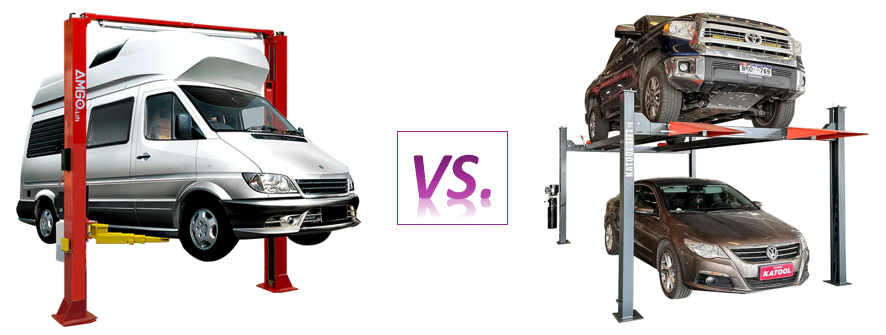
2-Post vs 4-Post Car Lifts: Features, Benefits, and Which One Is Right for You
If you're researching automotive lifts, one of the most common questions you’ll run into is: Should I buy a 2-post lift or a 4-post lift?
Both lift styles are extremely popular in garages and professional repair shops, but they serve different purposes. A lift that works perfectly for a repair shop might not be the best choice for someone looking to store vehicles in their home garage.
Understanding how each type of lift works—and what it’s best suited for—can make the decision much easier.
Understanding the 2-Post Car Lift

A 2-post lift raises the vehicle by the frame using adjustable lifting arms. Once the arms are positioned under the vehicle’s lifting points, the car is elevated and the wheels hang freely.
This design is why 2-post lifts are the most common type of lift used in professional repair shops.
Key Features of a 2-Post Lift
Full wheel access
Because the vehicle is lifted by the frame, the wheels are completely free. This allows technicians to easily perform work on:
-
brakes
-
suspension components
-
wheel hubs
-
steering systems
Open underside access
Without runways blocking the center of the vehicle, mechanics have easier access to:
-
transmissions
-
exhaust systems
-
fuel tanks
-
drivetrain components
This open workspace makes many repairs faster and easier.
Space efficiency
A 2-post lift has a relatively small footprint, which allows repair shops to fit multiple lifts in a limited amount of floor space.
Cost-effective for shops
In many cases, 2-post lifts are less expensive than comparable 4-post lifts, making them an excellent option for businesses focused on mechanical repair work.
Common Uses for 2-Post Lifts
2-post lifts are ideal for environments where frequent repairs and maintenance are performed, such as:
-
independent repair shops
-
dealership service departments
-
tire and brake shops
-
performance garages
For technicians who regularly work on suspension or drivetrain systems, the accessibility of a 2-post lift is hard to beat.
Understanding the 4-Post Car Lift

A 4-post lift operates differently. Instead of lifting the vehicle by the frame, the car drives onto two runways and is supported by its tires.
This design provides excellent stability and is one of the reasons 4-post lifts are widely used for vehicle storage and wheel alignments.
Key Features of a 4-Post Lift
Drive-on convenience
Using a 4-post lift is straightforward:
-
Drive the vehicle onto the runways
-
Raise the lift
-
Lock it into place
There’s no need to position lifting arms, which makes operation simple and quick.
Exceptional stability
Because the vehicle remains on its wheels, weight is distributed across four posts and the runways. This creates a very stable platform—ideal for long-term storage or heavier vehicles.
Perfect for vehicle storage
One of the biggest advantages of a 4-post lift is its ability to double your parking space.
Many people use them to store a second vehicle underneath the raised car, making them extremely popular in residential garages and among car collectors.
Ideal for wheel alignments
4-post lifts allow the vehicle’s suspension to sit naturally, which is important for accurate alignments. Many alignment racks are based on the 4-post design and include features such as turn plates and slip plates.
Common Uses for 4-Post Lifts
4-post lifts are frequently used for:
-
vehicle storage
-
wheel alignments
-
inspections
-
oil changes and exhaust work
-
dealership service lanes
They are also very popular in home garages because of their stability and ease of use.
Comparing 2-Post and 4-Post Lifts
While both lift styles raise vehicles safely, they excel in different areas.
| Feature | 2-Post Lift | 4-Post Lift |
|---|---|---|
| Wheel access | Excellent | Limited without bridge jack |
| Stability | Very good | Extremely stable |
| Storage capability | Not ideal | Excellent |
| Mechanical repairs | Best option | Moderate |
| Ease of operation | Requires arm positioning | Simple drive-on design |
| Floor space | Smaller footprint | Larger footprint |
Which Lift Should You Choose?
The best lift ultimately depends on how you plan to use it.
Choose a 2-Post Lift if you:
-
Perform frequent mechanical repairs
-
Need easy access to brakes, suspension, and wheels
-
Want maximum workspace under the vehicle
-
Are running a repair-focused shop
For technicians who regularly work on mechanical systems, a 2-post lift provides the accessibility needed to perform repairs efficiently.
Choose a 4-Post Lift if you:
-
Want to store vehicles and save garage space
-
Prefer a simple drive-on lifting system
-
Need a lift for alignments or inspections
-
Value maximum stability for long-term parking
4-post lifts are particularly popular with home garages, collectors, and alignment shops.
Final Thoughts
Both 2-post and 4-post lifts are excellent tools, but they’re designed with different priorities in mind.
A 2-post lift is the go-to choice for mechanics who need full access to the wheels and suspension for repairs. Meanwhile, a 4-post lift shines when stability, storage, and convenience are the main goals.
By understanding the strengths of each design, you can choose the lift that best matches your garage, shop workflow, and long-term needs.